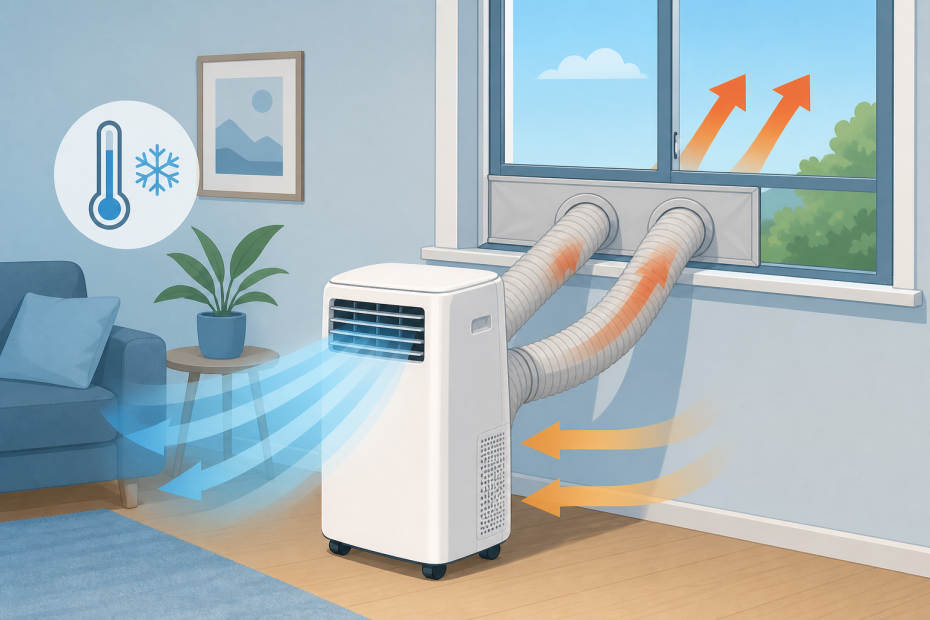
Portable air conditioners are the most flexible cooling option for renters, small spaces, and anyone who needs cooling in multiple rooms. They are also the least efficient type of AC if you buy the wrong size or set them up poorly. The difference between a portable AC that cools effectively and one that struggles comes down to three things: BTU rating, single-hose vs dual-hose design, and the quality of the window seal.
Portable Air Conditioner Guide: BTU, Single vs Dual Hose, and Setup Tips
Sponsored: This article features products from brand partner campaigns on Amazon. We may earn a commission from qualifying purchases made through the product links in this post, at no extra cost to you.
Portable ACs work by drawing warm air across a cold coil and exhausting the heat through a hose. Dual-hose units are 20–30% more efficient than single-hose because they do not create negative pressure that pulls warm air into the room.
The Short Answer
300 ft² → 8,000–10,000 BTU. 300–500 ft² → 10,000–12,000 BTU. 500–700 ft² → 12,000–14,000 BTU. Prefer dual-hose. Energy Star certified units use about 15% less electricity.
| Portable AC spec | What to check |
|---|---|
| BTU rating | Match to room square footage |
| Single vs. dual hose | Dual hose is more efficient |
| Window seal kit | Required for exhaust |
| Noise level | Decibels at sleep settings |
| Drain method | Bucket vs. self-evaporative |
BTU: What It Means
20 BTU per square foot of living space. A 10,000 BTU unit cools ~300 ft². Oversizing causes short cycling and poor humidity removal.
Single Hose vs Dual Hose
Single-hose creates negative pressure, reducing efficiency by 20–30%. Dual-hose has separate intake and exhaust, creating a closed loop. More efficient and quieter.
Window Seal Kit

The exhaust hose must be sealed to the window. A custom-fit seal kit or foam insulation panels are a worthwhile upgrade. Keep the hose as short and straight as possible.
Featured Products
A dual-hose portable AC with 14,000 BTU and Energy Star certification: See the dual-hose portable AC on Amazon.
A portable AC window seal kit with universal fit: See the AC window seal kit on Amazon.
FAQ
Is a portable AC as efficient as a window AC? No — window ACs are more efficient. Dual-hose portable ACs are the closest.
Can I use a portable AC in a room with no window? Not effectively — the exhaust hose must vent outdoors.
How often should I drain a portable AC? Most new units self-evaporate. In high humidity, drain every 8–12 hours.
Dual-Hose vs. Single-Hose: The Real Difference

The hose configuration is the most important technical decision in a portable AC. A single-hose unit pulls room air to cool the condenser and exhausts it outside — which creates negative pressure that draws warm outdoor air in through gaps, reducing efficiency. A dual-hose unit uses one hose for intake and one for exhaust, so it does not depressurize the room and runs more efficiently in hot conditions. The honest verdict: dual-hose units cost more but perform meaningfully better in real summer conditions, especially in rooms with poor sealing. If your budget allows, the dual-hose design is the one that delivers close to its rated BTU.
The BTU Truth: Ratings vs. Reality
Portable AC BTU ratings are measured under ideal conditions, and real performance differs for two reasons: the single-hose negative-pressure effect, and the fact that portable units cool the room more slowly than window units of equal BTU. The practical guidance is to size up: a room that a window unit would handle with 8,000 BTUs typically needs a 10,000–12,000 BTU portable to achieve the same comfort. The honest expectation: a portable AC is a good room cooler, not a whole-house system, and its job is best done in one room with the door closed.
Setup, Venting, and the Window Kit
Portable ACs require a window for the exhaust hose, and the included window kit is often the weak link — the flexible hose fits a range of window sizes, but the kit can let warm air in around the edges. The upgrade that matters: a properly fitted window seal (foam inserts or a custom panel) makes a measurable difference in efficiency. Set the unit away from walls and furniture so the intake and exhaust flow freely, and keep the hose as short and straight as possible — kinks and long runs reduce airflow. The drain situation also needs planning: most units have a condensate tank that needs emptying, or a drain hose to route the water somewhere sensible.
Noise and Placement
Portable ACs are the loudest cooling option — the compressor and fan live in the room with you. Typical units run 50–60 dB, which is noticeable in a bedroom. Placement strategy matters: put the unit near the window it vents to, keep the airflow aimed at the occupied area, and run it during the hottest hours, then switch to a fan at night if the noise bothers you. Units with sleep modes reduce fan speed overnight. If bedroom silence is critical, a window unit or mini split is the quieter alternative — worth the trade-off for light sleepers.
Key Takeaways
- 300 ft² → 8,000–10,000 BTU.
- 300–500 ft² → 10,000–12,000 BTU.
- 500–700 ft² → 12,000–14,000 BTU.
- Energy Star certified units use about 15% less electricity.
Disclosure: This article contains sponsored content and product links. If you make a purchase through the links in this post, we may earn a commission at no extra cost to you. Product evaluations are based on published specifications, industry guidance, and verified owner feedback.