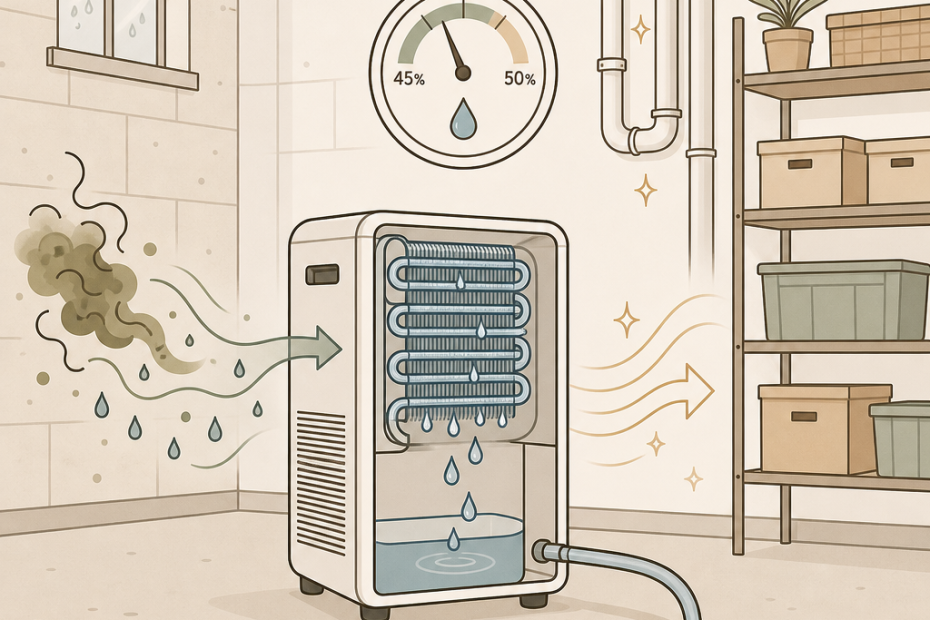
A dehumidifier in the basement is the single most effective fix for the musty smell, damp air, and condensation that plague below-grade spaces. But it is also an appliance people misunderstand: it does not fix leaks, it needs the right drainage setup, and used wrong it can waste electricity while the basement stays damp. The practical questions — will it actually remove the musty smell, what size do you need, and what are the downsides — have straightforward answers once you understand how these machines work. This guide explains what a basement dehumidifier can and cannot do, how to set it up for continuous operation, and where it fits alongside other moisture fixes.
Dehumidifier for Basement: What It Fixes, What It Doesn’t, and How to Use It Right
Sponsored: This article contains product links. We may earn a commission on qualifying purchases at no extra cost to you.
Is It a Good Idea to Put a Dehumidifier in the Basement?
Yes — for most homes, it is the most effective way to control basement humidity. Basements sit below grade, where cool soil keeps surfaces cold and moisture migrates in through walls and floors. That combination produces relative humidity above 60% for much of the year — the threshold where musty odors, condensation, and mold growth begin. A dehumidifier pulls moisture from the air and keeps relative humidity in the 30-50% range recommended for homes (EPA guide to moisture and mold).
Summary: A basement dehumidifier is worthwhile when humidity regularly exceeds 50-60%. It prevents musty odors, condensation on pipes, and mold growth — the three classic basement moisture problems.
Will the Musty Smell Go Away with a Dehumidifier?
Yes, in most cases — but only if the musty odor comes from damp air, which it usually does. Basement mustiness is caused by microbial growth (mold and mildew) thriving in high humidity. Remove the moisture and the microbial activity slows, and the odor fades over days to weeks as the space dries. Two caveats:
Existing mold keeps smelling. If mold has colonized walls, wood, or stored boxes, the dehumidifier dries the air but the colony keeps producing odor. Clean visible mold and remove moldy materials, then the dehumidifier maintains the dry conditions that keep it from returning.

Hidden moisture sources win. A dehumidifier cannot keep up with an active water leak, a damp crawl space, or groundwater seepage. Fix the source of water first; the dehumidifier handles the residual airborne humidity.
How a Basement Dehumidifier Works
Most basement dehumidifiers are compressor (refrigerant) models: a fan pulls air over cold coils, moisture condenses into a collection tank, and dry air returns to the room. This is the same principle as an air conditioner, which is why compressor dehumidifiers work best in warm conditions and lose efficiency in cold basements.
Key components:
- Compressor and coils — condense moisture out of the air
- Water tank — collects condensate (1-2 gallons / 3.8-7.6 L typical)
- Drain port — connects a hose for continuous drainage
- Built-in pump (on better models) — pushes water up and out through a hose
- Humidistat — cycles the unit to hold a target humidity
- Auto-defrost — prevents coil icing in cold basements
What Are the Downsides of a Basement Dehumidifier?
Being honest about the tradeoffs helps you use the machine correctly:
It costs electricity. A 50-pint Energy Star model uses roughly 400-500 kWh per year in humid climates — real money, but far less than the damage uncontrolled humidity causes. Energy Star models cut that cost by 20-30% (Energy Star dehumidifier program).
It needs emptying or drainage. Without a hose or pump, you empty a full tank every 1-3 days in a damp basement. The built-in pump or a gravity drain to a floor drain eliminates this chore.

Compressor models struggle in cold basements. Below roughly 65°F (18°C), coils ice up and efficiency drops. Models with auto-defrost handle this better; for unheated basements in cold climates, consider a desiccant dehumidifier, which works well at low temperatures.
It adds a little heat. Compressor units warm the air slightly as they run — usually unnoticeable, but relevant in a finished basement you also cool.
It filters only incidentally. The intake filter catches dust but a dehumidifier is not an air purifier — it will not remove airborne mold spores. Run a HEPA purifier separately if spore removal matters.
What Size Dehumidifier Does a Basement Need?
Capacity is rated in pints per day under the 2019 DOE test standard. Sizing guidance:
| Basement condition | Size | Recommended capacity (DOE 2019) |
|---|---|---|
| Moderately damp, up to 1,000 sq ft (93 m²) | Small-medium | 34-50 pints |
| Very damp, 1,000-1,500 sq ft (93-139 m²) | Medium-large | 50 pints with pump |
| Wet, large, or chronic moisture | Large | 70 pints or two units |
| Small spaces (crawl spaces, storage rooms) | Compact | 18-34 pints |
Most finished basements fall in the 50-pint category — it is the size experts recommend as the default for basements, balancing capacity, cost, and energy use.
How to Set Up a Basement Dehumidifier for Continuous Operation
- Choose the drainage method first. If a floor drain sits below the unit, connect a garden hose to the drain port for gravity drainage. If not, buy a model with a built-in pump and run the hose to a utility sink or window.
- Place it centrally, a few inches from walls, with airflow clearance around the intake and exhaust.
- Set the humidistat to 45-50% — dry enough to prevent mold and odor, without wasting energy.
- Raise it slightly off the floor if the basement has ever flooded.
- Clean the filter monthly and keep the coils free of dust — a dirty unit loses efficiency fast.
- Let it run continuously until the target humidity holds, then the humidistat cycles it automatically.
Recommended Basement Dehumidifiers
Best all-round choice: a 50-pint Energy Star model with a built-in pump handles the standard damp basement without bucket duty see the 50-pint dehumidifier with pump on Amazon.

For very damp, large basements: a 70-pint unit with pump keeps up with chronic moisture and large spaces check the 70-pint basement dehumidifier on Amazon.
For compact modern footprint: the Midea Cube-style design delivers strong dehumidification with a smaller, quieter build browse the Midea Cube dehumidifier on Amazon.
For cold unheated basements: a desiccant dehumidifier keeps working at low temperatures where compressor models lose efficiency see a desiccant dehumidifier on Amazon.
For pump-free gravity setups: a universal drain hose connects any unit with a drain port to a floor drain find the dehumidifier drain hose on Amazon.
Related Topics You May Find Helpful
Do I Need a Dehumidifier and a Sump Pump?
They solve different problems. A sump pump removes water that collects in the sump pit — groundwater flooding. A dehumidifier removes humidity from the air. A basement with both water intrusion and high humidity needs both.
Can a Dehumidifier Remove Radon?
No. Radon is a radioactive gas that enters through cracks and soil contact; dehumidifiers do not remove gases. If radon levels are elevated, test and install a radon mitigation system.
Should I Run the Dehumidifier in Winter?

Only if humidity stays above 50%. In winter, heated basements are often dry — running a compressor dehumidifier wastes energy and can ice the coils. In unheated cold basements, a desiccant unit is the right tool if moisture persists.
Frequently Asked Questions
How often do I empty a basement dehumidifier?
Without drainage, expect to empty a 1-2 gallon (3.8-7.6 L) tank every 1-3 days in a damp basement. Continuous drainage — gravity hose or built-in pump — eliminates emptying entirely.
Why does my dehumidifier ice up?
Cold basement air (below about 65°F / 18°C) freezes condensation on the coils. Use a model with auto-defrost, or switch to a desiccant dehumidifier for cold spaces.
Where should I put the dehumidifier in the basement?
Centrally, away from walls and corners, near the dampest area but not directly against it. Keep 6-12 in (15-30 cm) of clearance for airflow, and position it where you can reach the controls and drain.
Key Takeaways
- A basement dehumidifier fixes damp air, musty smell, and condensation — not leaks or existing mold colonies.
- Most basements need a 50-pint (2019 DOE standard) model; wet basements need 70 pints or two units.
- Set the humidistat to 45-50% and use continuous drainage — pump or gravity hose — to avoid bucket duty.
- Compressor models lose efficiency in cold basements; use auto-defrost or a desiccant unit.
- Fix water sources first, clean visible mold, then let the dehumidifier maintain dry conditions.