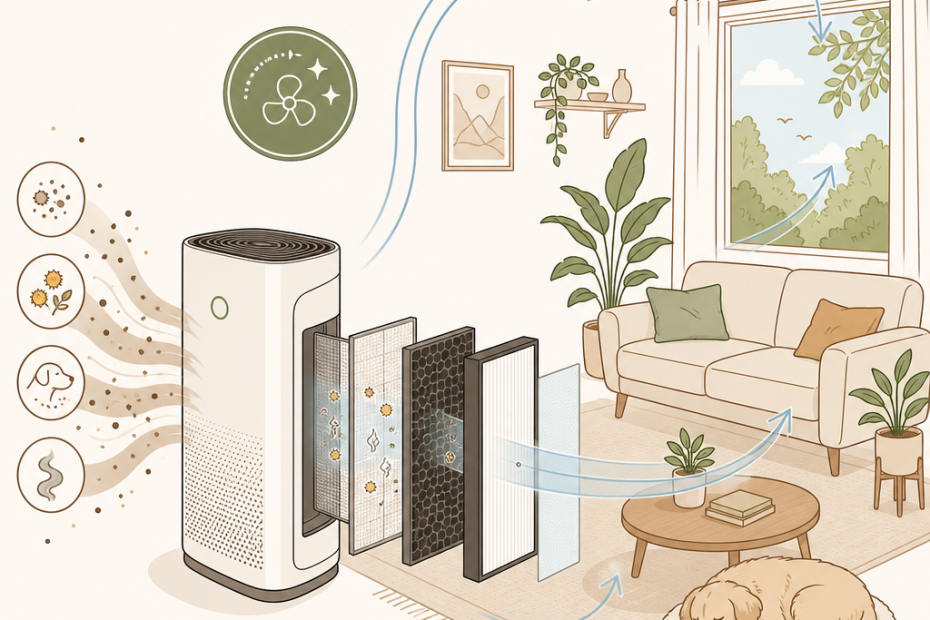
The best air purifier for a home is not the most expensive or the most feature-packed — it is the one sized correctly for the room, built around a true HEPA filter, and quiet enough to run continuously. Indoor air is typically two to five times more polluted than outdoor air, and a well-chosen purifier measurably reduces the particles that trigger allergies, asthma, and respiratory irritation. The brands that dominate expert recommendations — Coway, Winix, Levoit, Blueair — all share the same core: genuine HEPA filtration with a clean air delivery rate (CADR) matched to the space. This guide explains how to evaluate any air purifier, what the ratings actually mean, and which type suits your home.
Best Air Purifier for Home: How to Choose by Room, Filter, and CADR
Sponsored: This article contains product links. We may earn a commission on qualifying purchases at no extra cost to you.
Which Air Purifier Is Best for Home?
The best air purifier for most homes is a true HEPA model with a CADR matched to the room size, a carbon layer for odors, and quiet operation. Experts consistently rank models from Coway, Winix, Levoit, and Blueair at the top because they combine effective filtration with reasonable filter costs and low noise. For a typical bedroom or living room (150-400 sq ft / 14-37 m²), look for a smoke CADR of at least 150-300 CFM — the higher the CADR, the faster the room air is cleaned.
Summary: The best home air purifiers use true HEPA filters with CADR matched to room size. Coway, Winix, Levoit, and Blueair lead expert recommendations for their balance of filtration, noise, and filter cost.
What Doctors and Consumer Reports Recommend
Consumer Reports and medical organizations recommend air purifiers with true HEPA filters for people with allergies and asthma. The American College of Allergy, Asthma & Immunology notes that HEPA filtration can reduce airborne allergens when the purifier is sized to the room (ACAAI guidance on air purifiers). Consumer Reports’ top scorers are consistently HEPA-based units from Coway and Blueair, evaluated on particle removal, noise, and energy use.
The doctor-recommended essentials: true HEPA (99.97% capture at 0.3 microns), a CADR appropriate for the room, and continuous operation in the bedroom where people spend a third of their time.
How Air Purifiers Are Tested and Rated
CADR (Clean Air Delivery Rate) is the key number. Measured in cubic feet per minute (CFM), it tells you how quickly the purifier cleans the room. The Association of Home Appliance Manufacturers (AHAM) certifies CADR for smoke, dust, and pollen. A common recommendation: choose a purifier with a CADR of at least two-thirds of the room’s square footage — for a 300 sq ft (28 m²) room, at least 200 CFM smoke CADR.
Air changes per hour (ACH) is the practical result. A purifier delivering 4 ACH cycles the whole room’s air every 15 minutes — the level most experts recommend for allergy relief. Many top models deliver 4.8 ACH in their rated room size.
True HEPA vs. “HEPA-type”: only true HEPA filters are held to the 99.97% standard at 0.3 microns. “HEPA-type” or “HEPA-like” filters have no such guarantee.
Types of Air Purifiers Compared
| Type | How it filters | Best for | Considerations |
|---|---|---|---|
| HEPA + carbon | Mechanical filter captures particles; carbon adsorbs odors and gases | Allergies, dust, smoke, general use | The standard recommendation; filter replacement cost over time |
| Electrostatic / ionic | Charged plates attract particles | Low-maintenance users | Some models emit ozone — avoid ozone-generating units |
| UV-C | Ultraviolet light inactivates microbes | Supplementary disinfection | Limited value alone; best combined with HEPA |
| PECO (Molekule-style) | Photoelectrochemical oxidation destroys pollutants | VOCs and odors | Higher cost; evidence base smaller than HEPA |
The EPA’s guidance is straightforward: mechanical filtration (HEPA) is the proven, reliable method for removing particles from indoor air, and ozone-generating “air cleaners” should be avoided (EPA on air cleaners and HVAC filters).
How to Choose by Room Size
Small rooms (up to 150 sq ft / 14 m²): a compact HEPA unit with 100-150 CFM smoke CADR — nurseries, small bedrooms, offices.
Medium rooms (150-400 sq ft / 14-37 m²): the most popular category — 200-300 CFM smoke CADR. Covers standard bedrooms and living rooms.

Large rooms and open plans (400-800 sq ft / 37-74 m²): 300-500+ CFM smoke CADR, or two medium units placed apart.
Whole-home (1,000+ sq ft / 93+ m²): consider HVAC filtration upgrades (MERV 13 filters) or multiple portable units rather than one oversized purifier.
Filter Cost and Maintenance: The Hidden Decision
The purchase price is only half the cost — replacement filters are the other. Before buying, check:
Replacement filter price. Typical HEPA filter replacements run $20-80 and need changing every 6-12 months.
Filter life at your usage. Continuous 24/7 operation shortens filter life; most manufacturers rate filters on hours of use.
Availability. Popular models (Coway, Winix, Levoit) have filters widely stocked; niche brands can leave you hunting.

Washable pre-filters. A washable pre-filter extends the main HEPA filter’s life by catching large dust and pet hair first.
Recommended Air Purifiers for Home
Best overall for medium rooms: the Coway Airmega series combines true HEPA filtration, a smart air quality sensor, and low long-term cost — a perennial expert pick check a Coway Airmega air purifier on Amazon.
Best value: Winix models pair true HEPA with a washable pre-filter and carbon pellet layer at a lower price point browse Winix air purifiers on Amazon.
Best for large rooms: a high-CADR HEPA unit with an air quality sensor handles open living areas and high pollen seasons see the large-room HEPA purifier on Amazon.
Best quiet for bedrooms: a compact true HEPA purifier with a sleep mode runs unobtrusively through the night find a quiet bedroom air purifier on Amazon.
Related Topics You May Find Helpful
What Is the #1 Air Purifier?
There is no single #1 — the best unit depends on room size. In the popular 200-400 sq ft (19-37 m²) category, Coway Airmega models consistently top Consumer Reports and Wirecutter ratings for balanced performance and cost.
What Air Purifier Do Doctors Recommend?
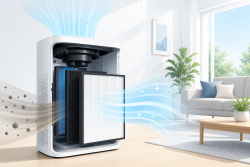
Allergists recommend true HEPA purifiers sized to the room, run continuously, with CADR matched to square footage. Brands like Coway, Blueair, and Winix are commonly cited because they meet those criteria.
Are Expensive Air Purifiers Better?
Not necessarily. Price reflects branding, sensors, and smart features as much as filtration. A mid-priced true HEPA unit with the right CADR cleans as effectively as a premium one — the difference is convenience features and filter cost.
Frequently Asked Questions
How many air changes per hour do I need?
For allergy relief, 4 air changes per hour (ACH) is the commonly recommended target — the purifier cycles the room’s air every 15 minutes. Check the manufacturer’s rated room size, which usually corresponds to 4 ACH.
Where should I place an air purifier?
Place it where you spend the most time — typically the bedroom — with 1-2 ft (0.3-0.6 m) of clearance on all sides, away from walls and furniture. Keep doors closed for best results in the room being cleaned.
How often should I replace the filter?
Typically every 6-12 months with continuous use, or when the indicator lights. Washable pre-filters should be cleaned monthly. A clogged filter sharply reduces performance.
Key Takeaways
- Choose true HEPA (99.97% at 0.3 microns) with CADR matched to room size.
- Coway, Winix, Levoit, and Blueair lead expert recommendations for home use.
- Aim for 4 air changes per hour in the room you clean most.
- Factor in replacement filter cost and availability — it is half the total cost.
- Avoid ozone-generating “air cleaners”; mechanical HEPA filtration is the proven method.